Why AI Transformation Is a Leadership Challenge
AI transformation is a leadership challenge, not just a technology challenge.
The question that sparked the debate was deliberately provocative: who should lead enterprise AI transformation, the CPO or the CTO?
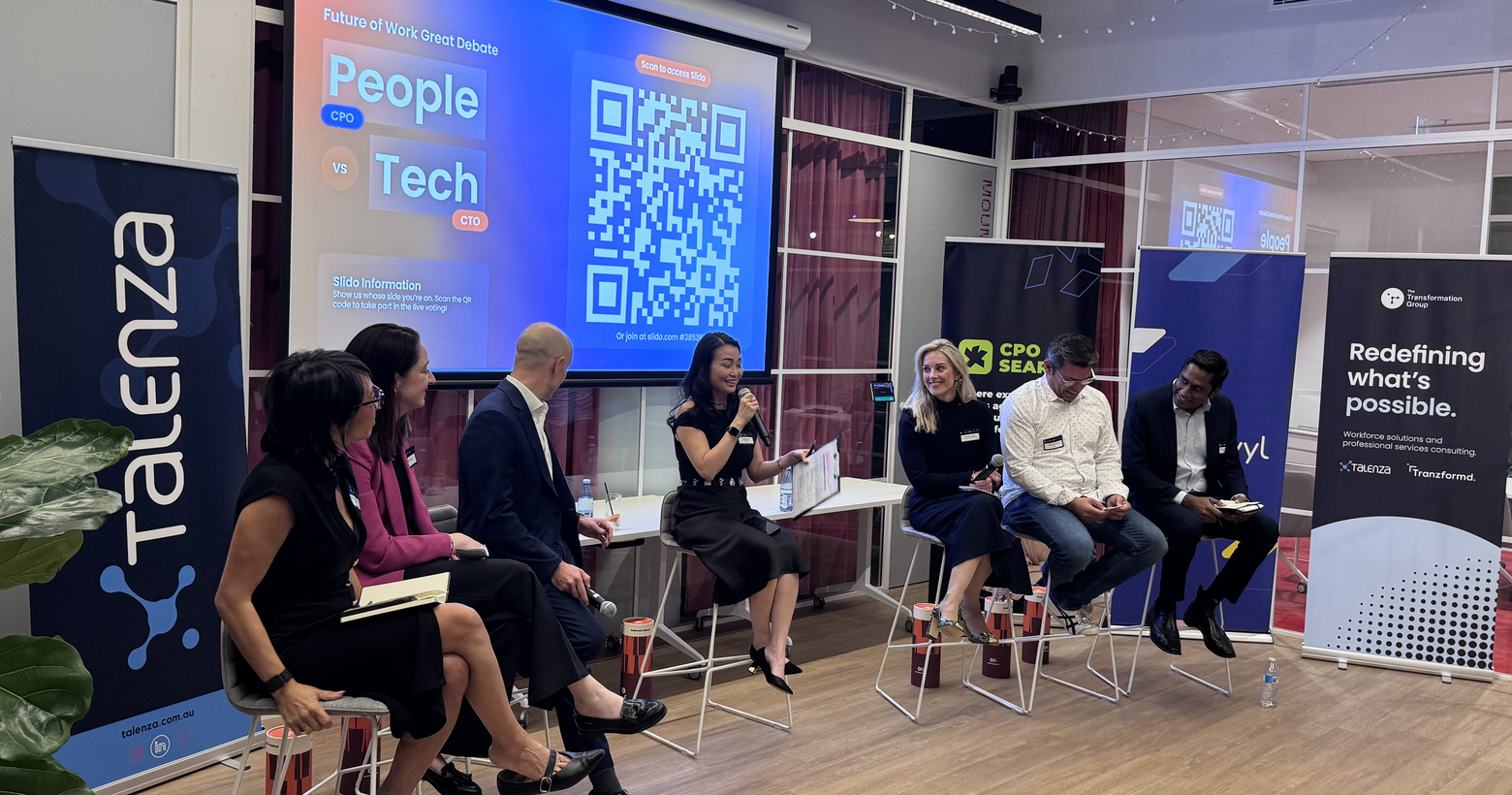
At CPO vs CTO: The Future of Work – The Great Debate, hosted by Levyl, CPO Search, Talenza and The Transformation Group, the room was split by design. Team CPO argued for people, culture, capability and leadership. Team CTO argued for architecture, AI governance, data discipline, security and execution.
And while Team CPO took the win on the night, the real answer was more nuanced.
As one guest put it after the event: “We keep asking who should lead AI transformation. It’s a distraction.”
That sentiment captured the heart of the discussion. AI transformation is not a turf war between Technology and People & Culture. It is a leadership challenge, a workforce capability challenge, and a transformation challenge all at once.
Technical fluency gets you into the room. Human leadership determines what happens next.
One of the strongest themes from the evening was that AI technical fluency matters. Leaders do not need to become engineers, but they do need to understand enough to ask better questions, challenge assumptions, interrogate risk and make informed decisions.
As one attendee reflected, organisations need technical leadership that understands the human layer of transformation, and people leadership with enough technical fluency to understand what AI is actually doing inside the business.
That combination is still rare.
For technology, transformation and digital leaders, the challenge is no longer only about choosing the right tools. It is about connecting platforms, data, AI governance and use cases to the real work of the organisation.
For people and culture leaders, the challenge is no longer only about engagement, adoption or change management. It is about workforce design, skills, trust, leadership capability and the way people make decisions in an AI-enabled workplace.
The future of work will require leaders who can operate across both.
The AI skills question is getting sharper
There was strong agreement in the room that enterprise AI adoption will demand a different set of leadership and workforce skills.
Critical thinking was one of the most repeated themes. As one guest noted, it is becoming essential for prompting, validating outputs and knowing when AI is wrong. That is not just a digital skill. It is a judgement skill.
Other skills came through clearly:
- Technical fluency
- Critical thinking
- Change leadership
- Emotional intelligence
- AI and data literacy
- Risk awareness
- Stakeholder influence
- Workforce planning
- Human judgement
- Learning agility
The point is not that every leader needs to become deeply technical. The point is that every leader now needs enough fluency to understand the opportunities, limitations and risks of AI in the context of their own function.
As one speaker put it: “A fool with a tool is still a fool.”
It was one of the most memorable lines of the night because it cut through the hype. Tools do not create value on their own. People do, when they have the capability, confidence and context to use them well.
AI investment and people investment are the same conversation
One guest captured this particularly well:
“Choosing whether to invest in AI or in people is a false dichotomy. They are the exact same investment.”
That is a useful challenge for organisations planning their AI transformation roadmap.
If the investment case only includes technology, platforms and productivity targets, it is incomplete. The value case also needs to include the leaders, teams and capabilities required to make AI work.
That means asking:
- Do we have the AI leadership capability to govern AI well?
- Do our teams know how to use AI safely and effectively?
- Are we developing the skills needed to validate, challenge and improve AI outputs?
- Do our leaders understand the workforce implications of automation and augmentation?
- Are we hiring for the future operating environment, or the one we already know?
For Talenza, this is where the talent conversation becomes critical. AI transformation will create demand for leaders who can bridge technology and business outcomes. It will also increase demand for AI transformation professionals who can lead through ambiguity, build trust, manage complexity and make change stick.
The winning organisations will build AI leadership capability around the technology
The CTO argument on the night was compelling. Without ambition, architecture, AI governance, data discipline, security and execution, AI remains “conversation theatre”. Organisations need the platforms, infrastructure and technical leadership to move from experimentation to scaled value.
But Team CPO’s winning argument was that AI technology alone is not enough. Culture, trust, capability and leadership determine whether AI is adopted, resisted, misused or embedded into the way work actually gets done.
The real opportunity sits in the combination.
The organisations that make the greatest progress will not be the ones with the biggest AI transformation budgets. They will be the ones with the right leaders in the right roles, working across technology, transformation and people to build the capability around the tools.
That is the AI leadership benchmark organisations are now expected to meet.
What this means for hiring
For organisations hiring technology, AI transformation and executive leaders, the brief is changing.
Technical credibility still matters. So does delivery experience. But the strongest candidates will also be able to show they can influence, educate, align and bring people with them.
The next generation of AI-ready leaders will need to be able to:
- Translate technical opportunities into business value
- Build trust with executive and board stakeholders
- Lead workforce change, not just systems implementation
- Balance innovation with AI governance, security and accountability
- Build AI capability in the teams around them
- Make decisions in environments where the technology is moving faster than the organisation
Enterprise AI transformation is already underway in most organisations, with or without a coherent strategy attached to it.
The question is whether leadership is ahead of it, aligned with it, or still catching up.
At Talenza, we help organisations find and hire the technology, transformation and leadership talent needed to deliver meaningful change. If you are thinking about the leadership capability your organisation needs next, we would be happy to continue the conversation.